

Beurer Magazine
Getting Active
Body analysis scales explained: what the numbers mean and which Beurer scale to choose
A body analysis scale shows more than your weight. It also gives you body fat, body water and muscle, all from a few seconds standing barefoot on the glass. The numbers help if you know what they can and cannot tell you. Here is how it works, how far to trust the numbers and how to weigh so the trend is real. Then we help you choose a Beurer scale for one person, a family or a home with WiFi.

Key takeaways
- The scale sends a tiny, harmless current through your body and works out body fat, water and muscle from how easily it passes. A workout, a meal or the time of day can shift the reading, so weigh the same way every time.
- For one person the body fat number can be several points out. Watch the direction it moves over weeks on the same scale, and do not worry about a single reading.
- Choose by household and connection. The BF 183 and BF 180 show everything on the scale. The BF 451 sends readings to the app by Bluetooth. The BF 980 and BF 990 send them over your home WiFi.
In this article
How a body analysis scale works
A body analysis scale sends a tiny, harmless electrical current up one leg and down the other. Muscle and water let the current through easily. Fat does not. The scale measures how easily the current passes. Then it uses your height, age and sex to work out body fat, body water and muscle. This method is called bioelectrical impedance analysis, or BIA for short.
Because the current travels through the water in your body, anything that changes your water balance changes the reading. A review of the method lists body position, recent exercise and food as things that can throw the result. It advises measuring at the same time of day when you compare readings.A So a hard workout, a big meal or a hot afternoon can shift your body fat reading, even when nothing in your body has really changed.
How accurate the numbers are
Accurate enough to follow a trend, but not exact for one person. A German study compared home body fat devices with a hospital body scan. A device with hand and foot electrodes was within about five to seven percentage points for most people. Scales that measure through the feet only were out by up to about 15 points for some people. The researchers said foot only scales work well for averages across a group, but less well for one person.B A 2021 study in France tested three smart scales and found that all three read body fat too low, by about two to four kilograms on average.C
So treat the body fat number as an estimate, not a fact. What counts is the direction it moves on the same scale over weeks. If your body fat goes down and your muscle holds steady or goes up, that is real progress. It counts even if the exact number is a few points out.

How to weigh so the trend is real
Same scale, same time, same routine. Beurer gives these steps on its scale pages:F
- Weigh first thing in the morning, after the toilet and before breakfast
- Wait about 15 minutes after you get up, so the water in your body can settle
- Stand barefoot and still on the metal electrodes, with your feet apart and your weight on both feet
- Put the scale on tiles or a wooden floor, never on a carpet or bathmat
- Wait a few hours after unusually hard exercise
It also helps to compare weekly averages, not one day against the next. Does stepping on the scale actually help you lose weight? A review of many trials found that weighing yourself works when it is part of a plan that also changes your eating and activity. There was no proof that weighing on its own helps, and daily weighing worked no better than weekly weighing.D The scale shows you how you are doing. It is not the plan itself.
Why this matters in South Africa
Many South Africans carry more weight than is healthy. The 2016 South Africa Demographic and Health Survey found that about two in three women and one in three men aged 15 and older were overweight or obese.E A scale will not change that on its own. But it gives you an honest picture of where you are, week by week. A scale that keeps a separate record for each person also turns weighing into a family habit, not a private worry. If you see a dietitian or a biokineticist, take your app graph along to your next visit.
Which Beurer scale to choose
All six scales measure weight, body fat, body water and muscle. The differences are how many people can use them, the extra readings, and whether the readings go to your phone.
| Model | Users | Readings go to | Power | Extras | Price today |
|---|---|---|---|---|---|
| BF 183 | 10 | Scale display | 1 x CR2032 battery | Visceral fat and metabolic age | R 409.00 |
| BF 180 | 10 | Scale display only, no app | 2 x CR2032 batteries | Bone mass and daily calorie need | R 439.00 |
| BF 451 LE26 | 8 | App, by Bluetooth | 3 x AAA batteries | 17 values in the app, limited edition finish | R 439.00 |
| BF 451 | 8, recognises who is on it | App, by Bluetooth | 3 x AAA batteries | 17 values in the app, stores 30 readings | R 549.00 |
| BF 990 WiFi | 8 plus a guest mode | App, by WiFi | 3 x AAA batteries | Hand grip, arms, legs and body measured separately, heart rate | R 1,719.00 |
| BF 980 WiFi | 8, recognises who is on it | App, by WiFi | Built in battery, charges by USB | Heart rate, extra large display | R 2,199.00 |
- For readings on the scale itself: the BF 183 keeps profiles for 10 people and adds visceral fat, the fat around your organs, and a metabolic age. The BF 180 also keeps 10 profiles and adds bone mass and how many calories you need a day.
- For your phone, by Bluetooth: the BF 451 shows the main readings on the scale and 17 values in the free Beurer HealthManager Pro app. It keeps 8 profiles and recognises who is standing on it. The BF 451 LE26 is the same scale in a limited edition finish.
- For WiFi: the BF 980 WiFi and BF 990 WiFi are set up once by Bluetooth, then send every weigh in to the app over your home WiFi. You do not have to open the app first. Both also measure your heart rate. The BF 980 charges by USB, so there are no batteries to buy.
- For the most detail: the BF 990 WiFi has a hand grip as well as the foot plates. It measures your arms, legs and body separately, and has a guest mode for visitors. Without the hand grip it measures weight only.
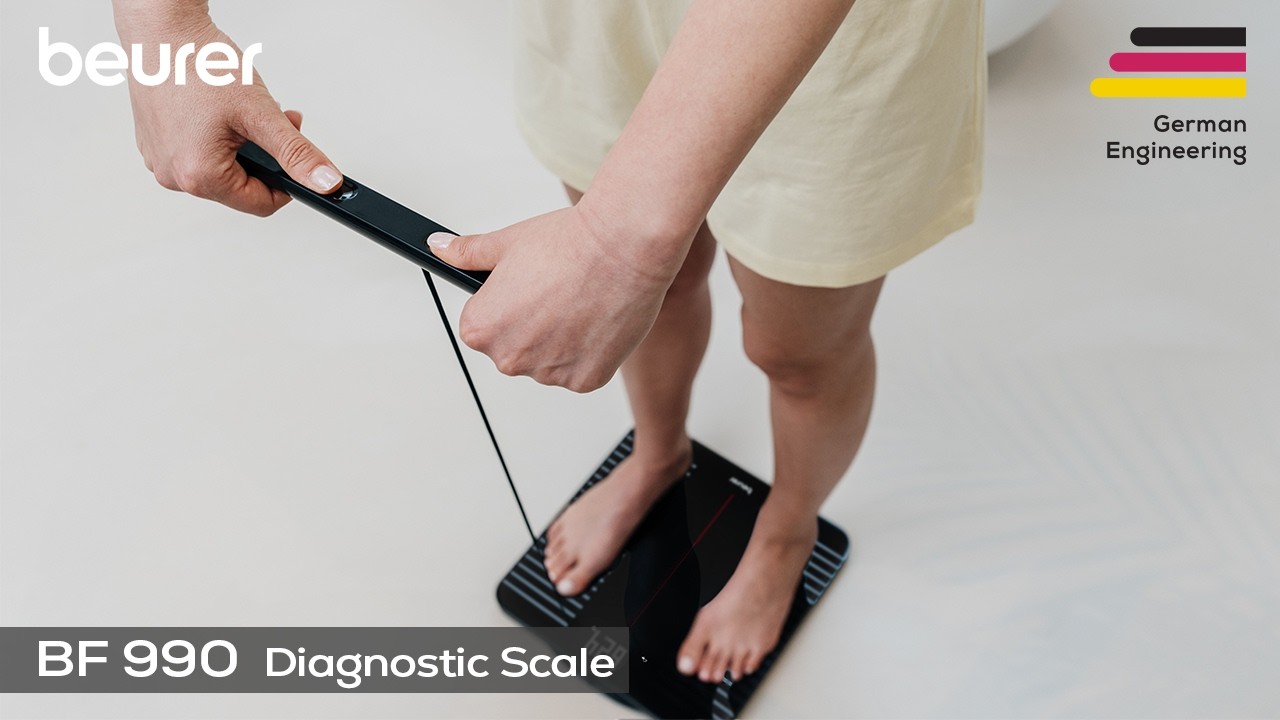 Watch the video
Two limits apply to all of these scales. Beurer says they are not suitable for anyone with a pacemaker or other medical implant, or during pregnancy. And the BMI reading only works within a normal range of height to weight. It may not show for people who are very tall and light, or very short and heavy.
From the Beurer South Africa shop

Beurer BF 183 LE25 Diagnostic Bathroom Scale: Weight, Body Fat, Body Water, Muscle Percentage, BMI, Visceral Fat & Metabolic Age
Beurer
Beurer Germany Diagnostic Scale | Body Fat Bathroom Scale, BMI, Muscle BF 180
Beurer
Beurer Germany Body Fat Scale | 17 Health Parameters | 8 Users | BF 451 LE26
Beurer
Beurer BF 451 Diagnostic Bathroom Scale | Bluetooth App | Weight, BMI, Body Fat, Water, Muscle, Bone & More
Beurer
Beurer Germany BMI Scale, WiFi Body Composition Scale BF 990
Beurer
Beurer BF 980 WIFI Diagnostic Bathroom Scale | BMI, Fat, Muscle, Heart Rate & More| Monitor via App | USB Recharged
BeurerCommon questions about body analysis scales
How accurate are body fat scales?
Good enough to follow a trend, but not exact for one person. In one study, a device with hand and foot electrodes was within about five to seven percentage points of a body scan for most people. Scales that measure through the feet only were out by up to about 15 points. Weigh the same way each time and watch how the number moves over weeks.
When is the best time to weigh yourself on a body analysis scale?
First thing in the morning, after the toilet and before breakfast, barefoot and without clothes. Beurer suggests waiting about 15 minutes after you get up. Keep the same routine every time, because that matters more than the exact hour.
Does weighing myself every day help me lose weight?
Weighing yourself helps when it is part of a plan that also changes what you eat and how active you are. On its own, there is no proof that it helps. One review also found that daily weighing worked no better than weekly weighing.
Which Beurer scale works with an app?
The BF 451 sends readings to the free Beurer HealthManager Pro app by Bluetooth. The BF 980 WiFi and BF 990 WiFi are set up once by Bluetooth, then send every weigh in to the app over your home WiFi. The BF 183 and BF 180 show your readings on the scale itself.
Who should not use a body analysis scale?
Beurer says its body analysis scales are not suitable for anyone with a pacemaker or other medical implant, or during pregnancy. Body fat readings can also be off for children under about 10, top athletes and bodybuilders, and people with swelling in the legs, osteoporosis or a fever.
Sources:
A Campa F, Toselli S, Mazzilli M, Gobbo LA, Coratella G. Assessment of body composition in athletes: a narrative review of available methods with special reference to quantitative and qualitative bioimpedance analysis. Nutrients 2021; 13(5): 1620
B Bosy-Westphal A, Later W, Hitze B et al. Accuracy of bioelectrical impedance consumer devices for measurement of body composition in comparison to whole body magnetic resonance imaging and dual X-ray absorptiometry. Obesity Facts 2008; 1(6): 319 to 324
C Frija-Masson J, Mullaert J, Vidal-Petiot E et al. Accuracy of smart scales on weight and body composition: observational study. JMIR mHealth and uHealth 2021; 9(4): e22487
D Madigan CD, Daley AJ, Lewis AL, Aveyard P, Jolly K. Is self-weighing an effective tool for weight loss: a systematic literature review and meta-analysis. International Journal of Behavioral Nutrition and Physical Activity 2015; 12: 104
E South Africa Demographic and Health Survey 2016: fast facts. The DHS Program, fact sheet DM142
F Beurer South Africa. BF 451 diagnostic bathroom scale, instructions for taking measurements correctly. beurer.co.za
This article offers general information and does not replace advice from your doctor or pharmacist.